
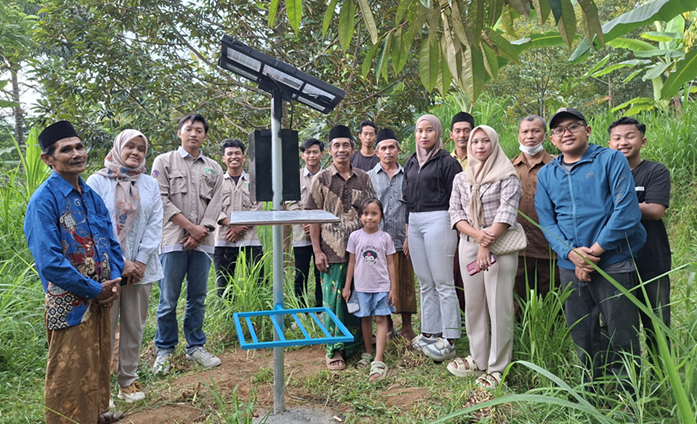
Durian season in Indonesia not only brings sweet fruit but also leaves behind mountains of discarded durian rinds, often creating foul odors, attracting flies, and piling up in landfills. Responding to this environmental issue, lecturers from Politeknik Negeri Jember (Polije) have launched a community service program to convert durian waste into activated charcoal while introducing solar-powered pest control technology.
The initiative, led by lecturers Setyo Andi Nugroho, Risse Entikaria Rachmanita, and Devina Cinantya Anindita, was supported by the Directorate of Research and Community Service (DPPM). Local residents of Klungkung Village, Jember Regency, took part in hands-on training to process durian rinds into valuable products while adopting environmentally friendly technology. “Indonesia has an abundance of durians, which means plenty of waste. If left unmanaged, it’s just garbage. But when processed, durian rinds can be turned into activated charcoal with strong market potential,” explained Setyo Andi.
During the training, villagers learned a step-by-step process: drying the durian rinds, carbonizing them at 350–400°C for an hour, filtering the product through a 100-mesh sieve, and chemically activating the charcoal. The result is high-quality activated charcoal with applications in odor absorption, water filtration, and even as a raw material in food, cosmetics, and pharmaceuticals. Residents also received guidance on packaging and digital marketing strategies to expand sales through social media and e-commerce platforms.
Beyond waste management, the program also introduced solar-powered insect traps for durian orchards. By harnessing solar energy to power lamps that attract pests, farmers can reduce crop damage without relying on chemical pesticides. This innovation not only protects fruit quality but also supports sustainable farming practices.
The program has delivered multiple benefits: cleaner surroundings, new income opportunities for villagers, and healthier durian harvests. “This innovation proves that modern agriculture is not only about boosting production but also about sustainability. What was once seen as waste can now become a source of prosperity,” Setyo emphasized.