
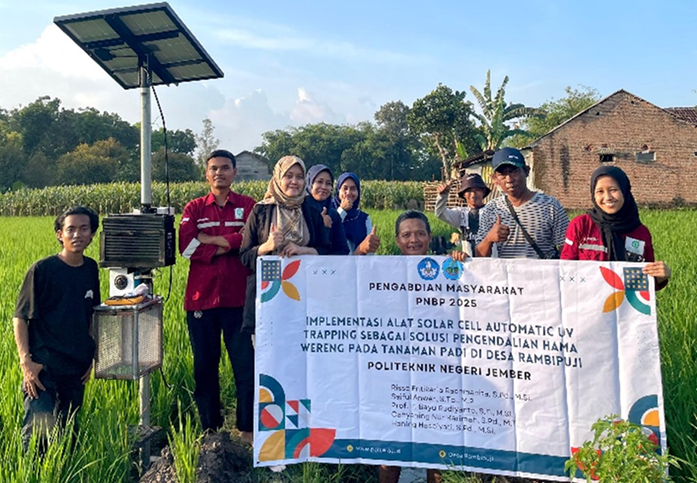
A team of lecturers and students from Politeknik Negeri Jember (Polije), Indonesia, has launched an environmentally friendly innovation called the Solar Cell Automatic UV Trapping System to help control brown planthopper infestations in rice fields. The initiative, carried out under the Community Service Program (PkM), took place in Rambipuji Village, Jember Regency, and aims to reduce farmers’ reliance on chemical pesticides.
The project was led by Risse Entikaria Rachmanita, S.Pd., M.Si., along with lecturers and students from the Renewable Energy Engineering program. She emphasized that the technology highlights the potential of solar energy beyond household electricity. “Through this device, we want to show farmers that solar power can also improve agricultural productivity in a sustainable way,” Risse explained during the activity.
Local leaders welcomed the program as a breakthrough for the farming community. Rambipuji Village Head Dwi Diyah Setyorini, S.I.Kom., noted that farmers had long depended on pesticides despite abundant sunlight in the region. “The presence of Polije gives us new insights into eco-friendly farming methods that harness renewable energy,” she said.
The device works by using a solar-powered UV lamp to attract and trap brown planthoppers, a major threat to rice crops. Farmers also received training on how to operate and maintain the equipment, ensuring they can use it independently. One farmer, Slamet, shared his experience: “We used to spray pesticides once a week. Now we have a safer, cheaper alternative. Hopefully, this will improve our harvests.”
Through this program, Polije is not only providing a technical solution but also promoting knowledge transfer to rural communities. Risse added that the initiative aims to make Rambipuji a model for green energy-based agriculture, supporting both food security and clean energy in line with the United Nations Sustainable Development Goals (SDGs).