
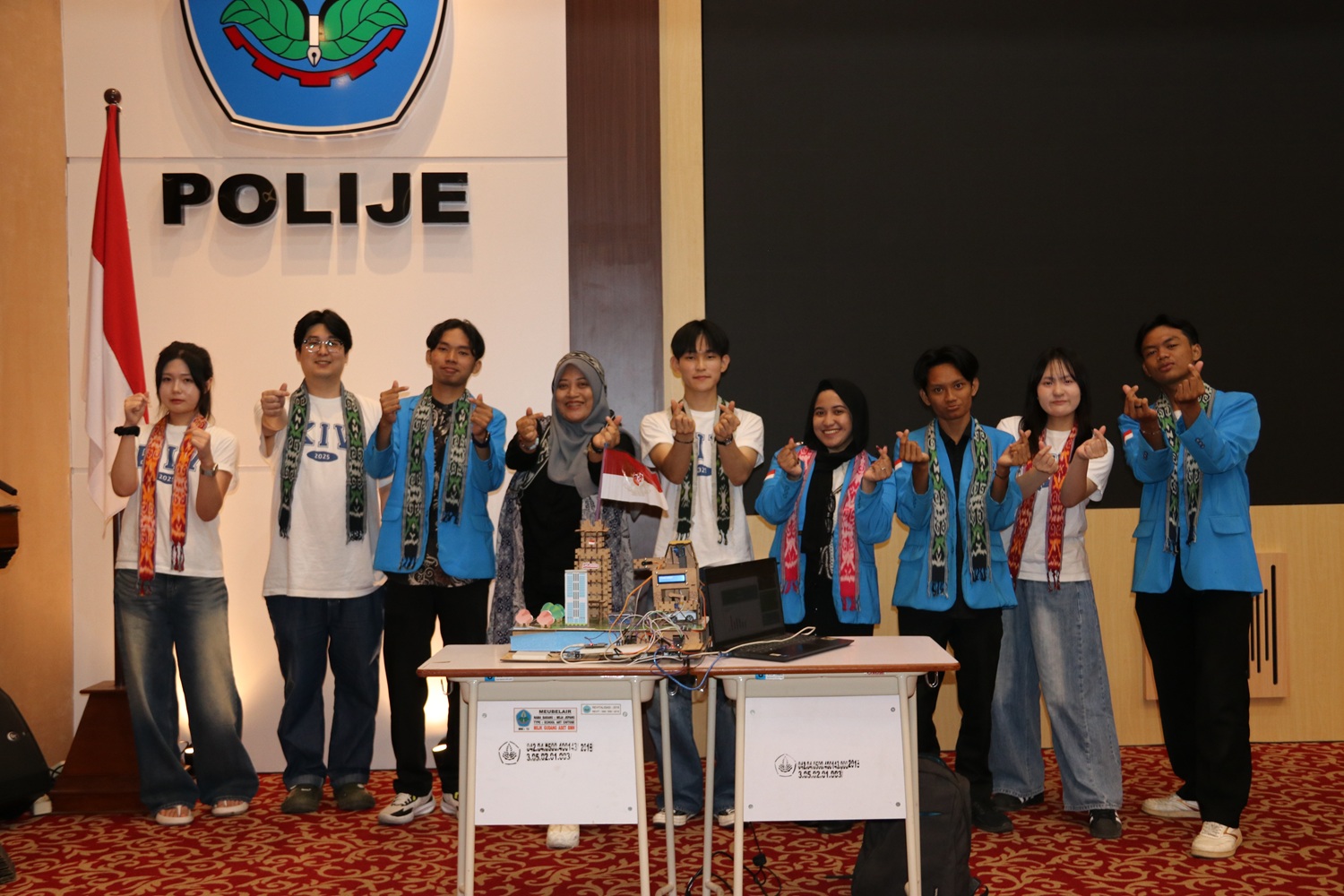
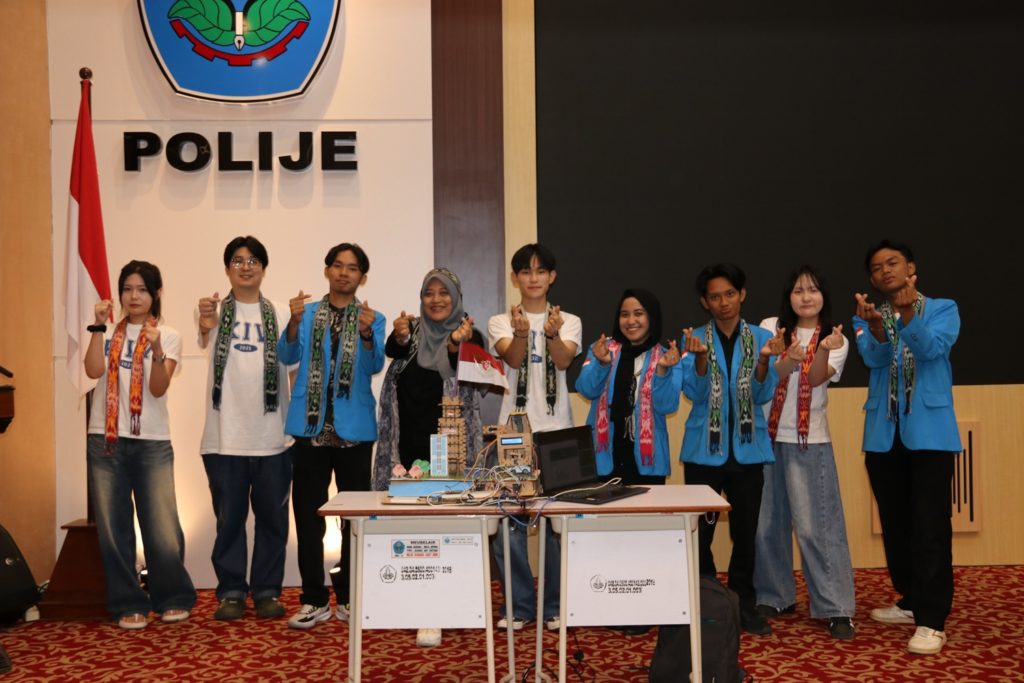
Under the 2025 World Friends Korea-ICT Volunteering Program (WFK-ICT), students from Kyungpook National University (KNU), South Korea, and Politeknik Negeri Jember (POLIJE), Indonesia, collaborated to tackle one of Bondowoso’s pressing environmental challenges: waste management. Their project, developed by Team 6: 8-BIT IT, introduced an innovative Smart Trash Bin with Automatic Compactor System designed to make city waste disposal more efficient.
The team consists of eight members, four from KNU—Moon Byungsoo (Project Leader), Yu JiHwan (Design Leader), Kim Minseo (Technology Leader), and Kim Ilyeo (Knowledge Leader)—and four from POLIJE—Krisna Panca Dewa (Design Leader), Revi Ardiano Ramadhani (Technology Leader), Regina Qothrun Nada (Knowledge Leader), and Rahmat Rendi Prayogo (Technology Leader). Together, they brought diverse expertise from different majors and cultural backgrounds.
The project was inspired by three major problems observed in Bondowoso: large amounts of trash scattered on the streets, the lack of public trash bins, and inefficient use of existing bins where empty space inside is often wasted. These issues contribute to environmental pollution and poor waste management practices in the city.
To address these problems, the Smart Trash Bin design integrates an ultrasonic sensor to detect the level of trash inside the bin. Once the trash reaches a certain height, a servo motor activates a compaction plate to compress the waste, creating more space and maximizing bin capacity. For safety, a buzzer alerts users during compression, while an LCD display shows the bin’s status, such as normal use, compressing, or compression completed.
The system also includes a monitoring page connected through ESP microcontrollers, allowing real-time tracking of trash levels and bin conditions. This feature ensures that waste management authorities can monitor bin capacity remotely and plan timely collection, reducing overflow and unnecessary waste pickups.
During development, the team conducted optimization in several areas: stabilizing ultrasonic sensor readings, reducing servo motor energy consumption, and adjusting LCD brightness to save power. They also worked on modularizing the software code, minimizing memory usage, and improving system stability through proper wiring and external power support. These refinements ensured that the prototype could run efficiently in real-world scenarios.
In their evaluation, the team highlighted the strengths of their project, including its fresh concept, clear functionality, and environmental benefits. They also noted areas for improvement, such as enhancing the physical design of the bin to be more user-friendly and suitable for public spaces. Despite these challenges, the prototype demonstrated significant potential for adoption in urban waste management systems.
The Smart Trash Bin project reflects how student-led international collaboration can provide practical solutions to local problems while contributing to global sustainability goals. For Bondowoso, the innovation represents a step toward a cleaner, smarter city, supporting broader efforts in environmental conservation and smart city development.