
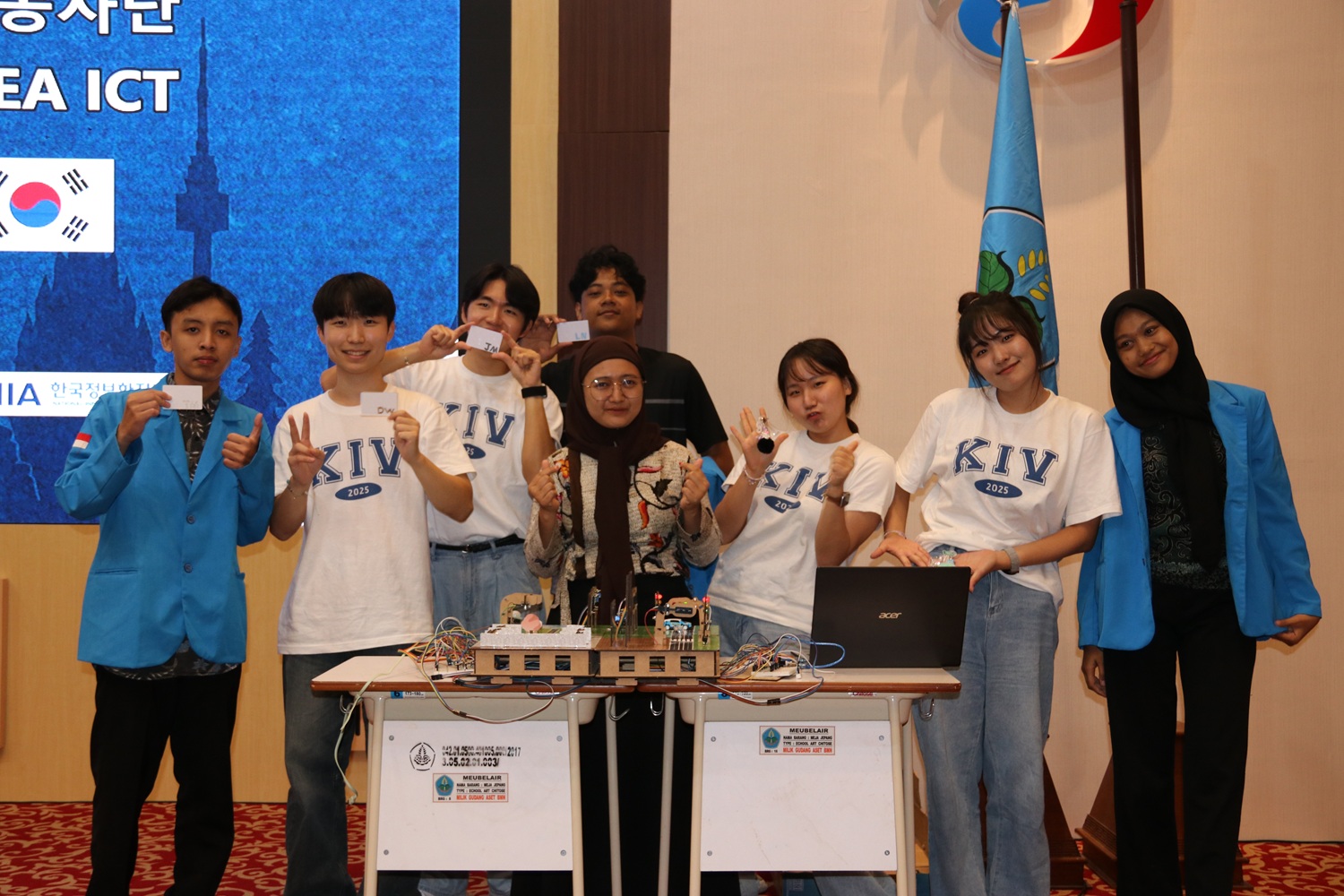
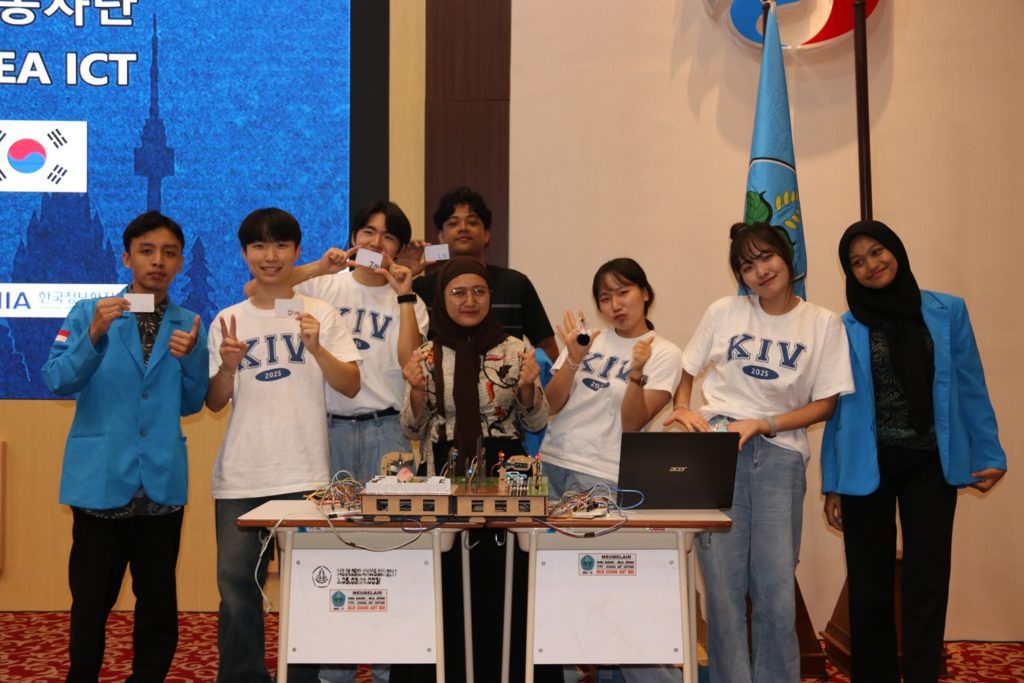
The 2025 World Friends Korea-ICT Volunteering Program (WFK-ICT) has enabled international students from Kyungpook National University (KNU), South Korea, and Politeknik Negeri Jember (POLIJE), Indonesia, to develop technology-based solutions for Bondowoso. Among the highlights of this collaboration is the BondoWOWso Team, which focused on improving traffic management and safety through their Smart Traffic System project.
The BondoWOWso Team consists of talented students including Kim Dongwoo, Choi Dahyeon, Kim Minsong, and Kim Jaemin from KNU, working together with Muhammad Fitra Abdi Tama, Ach. Humaidi, Aidil Kamal, Olla Nura Aura Fadillah, and Maulana Ali Mubarok from POLIJE. Their advisor, Dia Bitari Mei Yuana, guided the group throughout the project’s implementation.
Their initiative was inspired by several urban challenges observed in Bondowoso, such as low pedestrian safety, irregular parking, and insufficient street lighting. In response, the team envisioned a transformation “From Chaos to Control,” delivering technological solutions that prioritize safety, efficiency, and sustainability.
The Smart Traffic System includes three main innovations: Touch-Button Pedestrian Crossing Lights, which allow safer road crossings for residents; Smart Street Lighting, equipped with ambient light and motion sensors to save energy; and an RFID-Based Smart Parking System, designed to improve parking efficiency while integrating IoT technology for real-time monitoring.
To build the system, the team used modern tools such as the ESP32 dual-core microcontroller, RFID authentication, ultrasonic sensors, and LCD displays. These technologies allow accurate vehicle detection, secure access, and reliable data collection. A web-based interface was also developed to provide parking availability and fee details to users.
The project further introduced an expansion model, envisioning integration with Indonesia’s future parking ecosystem. By connecting real-time parking data to big data analytics, the Smart Traffic System could support long-term urban planning and sustainable infrastructure development.
Through prototyping and simulation, the BondoWOWso Team tested their solutions and gathered constructive feedback. The results showed promising applications that could be scaled up to enhance traffic management and improve public safety in Bondowoso.
This collaboration reflects the broader goals of the WFK-ICT Program: fostering innovation, cultural exchange, and sustainable community impact. By combining Korean expertise with Indonesian local knowledge, the BondoWOWso Team demonstrated how student-driven projects can contribute to shaping smarter, safer, and more efficient cities.