

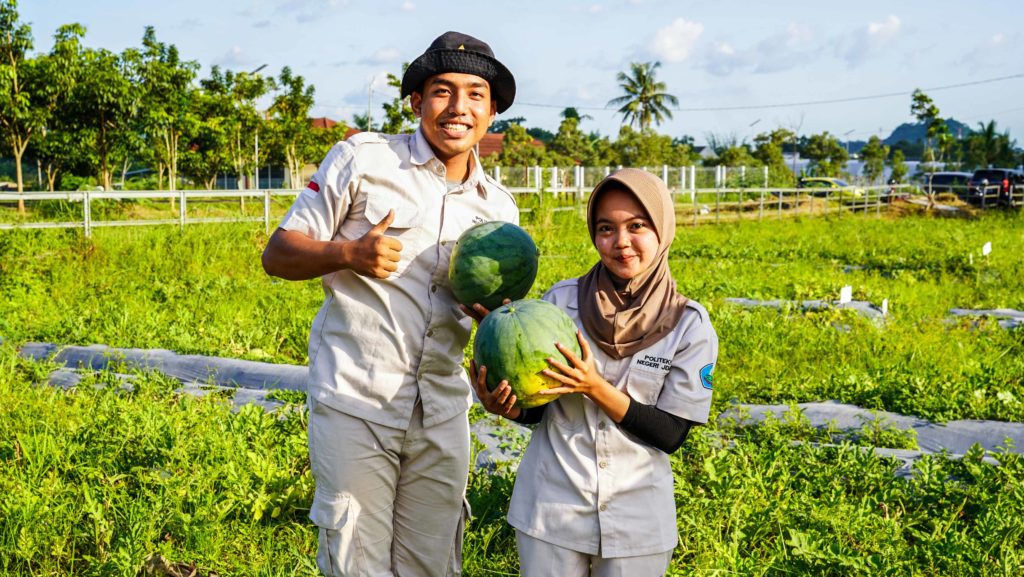
The Project-Based Learning (PBL) method has once again proven its effectiveness in fostering an innovative generation in vocational education. Students of the Diploma Three (D3) Agribusiness Management Study Program at Politeknik Negeri Jember (Polije) have achieved tangible outcomes by producing high-quality watermelons cultivated independently at the Innovation Garden Teaching Factory.
This activity is part of the practical course during the even semester of the 2024–2025 academic year. The students were actively involved in the entire horticultural production process—ranging from planning, seed selection, land preparation, planting, maintenance, pollination techniques, harvesting, marketing, to business analysis. All stages were integrated into a project-based learning method aimed at enriching students’ hands-on experience in agribusiness.
Dhani Mas Ahmad Ilyasa, one of the PBL participants, shared his enthusiasm for the project.
“This PBL is carried out in the form of a practical session under the Horticultural Crop Production course. We planted watermelons as our chosen commodity. Through this PBL, we learned to understand the cultivation process from seed selection to harvest,” he said.
Dhani further explained that the harvested watermelons would be divided into two purposes: some would be sold, while the rest would be processed into value-added products for the upcoming Product Exhibition.
“We hope this year’s harvest will be better and more satisfying than the previous year,” he added.
Linda Ekadewi Widyatami, the supervising lecturer and Coordinator of the D3 Agribusiness Management Study Program, stated that this PBL involved two main courses: Horticultural Crop Production and Agribusiness Management.
“The products harvested are from two watermelon varieties: Black Sweet Dewangga and Seedless Amara. In this activity, students are trained not only in technical cultivation aspects but also in business planning, product processing, and feasibility analysis. It offers them a complete end-to-end experience,” explained Linda.
She added that the project runs for a full semester, culminating in a harvest period that began in late April. The produce is marketed through the Innovation Garden network and student channels, and will also be featured in the PBL Product Exhibition.
“This activity does more than prepare students to be competent in agricultural production; it also cultivates an entrepreneurial mindset. We aim for our graduates to build new agriculture-based ventures and contribute meaningfully to national food security,” Linda emphasized.
In addition to fresh watermelon production, students also developed various watermelon-derived products, such as juice, jam, and healthy snacks. This initiative aims to increase product value and open up new business opportunities.
More than just an academic project, this PBL initiative also represents Polije’s concrete support for the national food security program. By introducing students to agribusiness management grounded in innovation and technology, Polije aspires to produce graduates ready to tackle challenges in the agricultural business and industrial sectors.
“Moving forward, the Agribusiness Study Program and the Innovation Garden will continue collaborating to further develop this project-based practical learning model, strengthening graduates’ competencies in both technical production and managerial skills,” concluded Linda Ekadewi Widyatami.
With the first harvest already yielding visible results, it is hoped that this blend of academic and hands-on fieldwork will serve as a model for more practical, productive, and empowering vocational education, fostering the independence of Indonesia’s young generation in the agribusiness sector. (rda)