

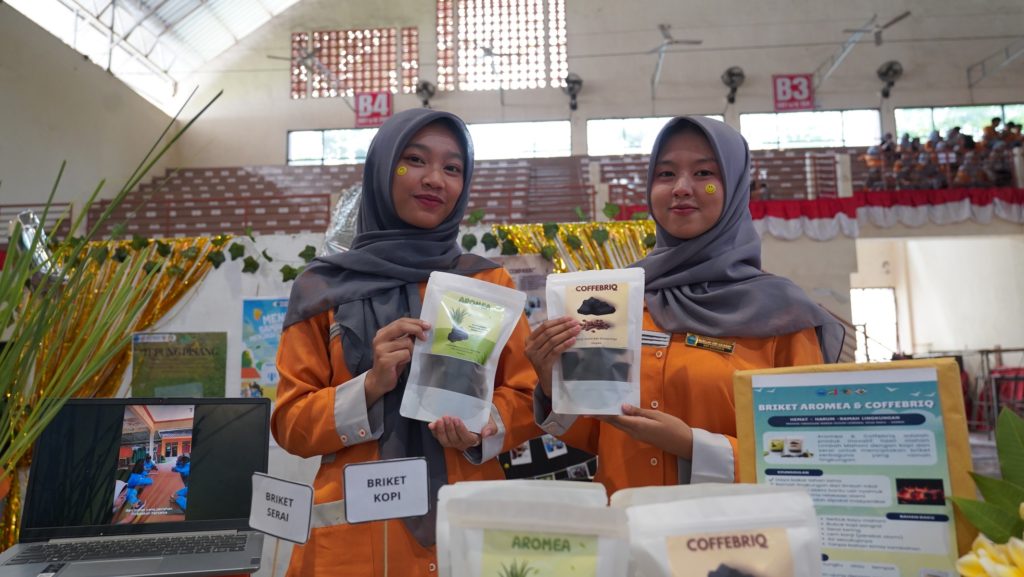
Students from the Health Promotion Study Program at Politeknik Negeri Jember (Polije), grouped under the name Briket Bioarang Cempaka A2, have developed an eco-conscious innovation in the form of aromatic briquettes made from Mahogany wood waste. Their environmentally friendly creation comes in two natural fragrance variants: Coffebrique, infused with coffee aroma, and Aromea, featuring lemongrass scent.
This student-led initiative addresses a pressing environmental issue in Dusun Cempaka, where Mahogany wood waste has long remained unutilized. By converting it into value-added products, the team not only promotes sustainability but also opens up new opportunities for local economic empowerment.
Team member Mediana Widia Putri explained that the abundance of unprocessed Mahogany wood inspired them to act.
“Mahogany wood waste in Dusun Cempaka is abundant but underutilized. We wanted to transform it into something useful and marketable,” she said.
The production process is straightforward and community-friendly. It involves carbonizing Mahogany wood into charcoal, grinding it into fine powder, and then blending it with dried coffee grounds or lemongrass. Natural tapioca starch dissolved in hot water is used as an adhesive. The mixture is molded, dried, and transformed into clean-burning aromatic briquettes.
“Our goal is for this process to be replicable by local residents. It’s not just about being eco-friendly, but also creating an economic opportunity for the community,” Mediana added.
So far, the products have been marketed directly to residents of Dusun Cempaka and promoted through social media platforms such as Instagram. Community response has been encouraging, particularly due to the natural fragrances and the briquettes’ smokeless burning quality—making them a healthier and cleaner alternative to conventional fuels.
“We hope this innovation inspires long-term change. If the community continues production sustainably, we can manage waste effectively, protect the environment, and boost the local economy,” Mediana expressed.
This project exemplifies how grassroots innovation can produce tangible benefits by integrating environmental awareness with community engagement. As global concerns about climate change, pollution, and waste management intensify, such locally-driven solutions resonate well with the broader international agenda for sustainable development.
Moreover, the initiative highlights the global potential of vocational students in Indonesia. Through simple yet impactful solutions like Coffebrique and Aromea, Polije students demonstrate how higher education can equip young innovators to address real-world problems creatively and sustainably.
Their success also reflects Indonesia’s growing role in regional sustainability efforts and its commitment to promoting green innovation at the community level—an example of how local actions can contribute to global goals. (rda)