
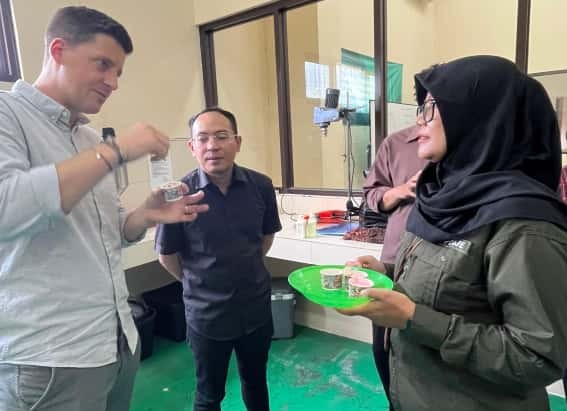
The fourth day of the international workshop at Politeknik Negeri Jember (POLIJE) shifted focus to yoghurt production, held at the Agricultural Technology Laboratory. This session introduced participants to the unique processes of fermented dairy products, expanding their knowledge beyond milk pasteurization and sterilization. By highlighting the role of microbial activity, the training deepened participants’ understanding of food science and its applications.
Guided by POLIJE teachers, the session emphasized the scientific principles that differentiate yoghurt production from other dairy processes. Educators explained how microbial fermentation not only influences product safety but also creates distinctive textures and flavors that are highly valued in the food industry. The clarity of instruction ensured that participants could connect theory with practical outcomes.
Hands-on activities became the centerpiece of the session. Participants were actively involved in preparing yoghurt cultures, monitoring fermentation times, and evaluating the texture and taste of the final product. This direct involvement enabled them to experience the variability of the process while learning how to control quality outcomes.
The consultants from Skills for Competitiveness (S4C) praised the pedagogical approach used by POLIJE teachers. They noted that the combination of scientific explanation and technical practice provided an engaging learning environment that encouraged curiosity and participation. This balance of academic and practical elements reflected best practices in vocational training.
Teachers emphasized that yoghurt production is an excellent example of how problem-based learning (PBL) can be applied in laboratory settings. By inviting participants to observe, question, and analyze the results of their own work, the session promoted critical thinking alongside technical skills. This approach reinforced POLIJE’s philosophy of experiential learning.
Participants expressed enthusiasm for the session, noting that the knowledge gained was highly transferable to their own teaching or professional contexts. Many remarked that being directly involved in the production process enhanced their confidence in replicating similar activities in their respective institutions or industries.
The session also demonstrated POLIJE’s broader commitment to aligning its teaching factory model with industry practices. By equipping participants with both practical skills and scientific understanding, the institution is fostering a generation of educators and professionals who are capable of bridging the gap between academic learning and industrial application.
Through innovative sessions like this, POLIJE continues to advance its vision of becoming a polytechnic of excellence. By integrating global insights, practical training, and problem-based learning, the institution is shaping not only competent graduates but also educators who can drive vocational education forward in Indonesia and beyond.