
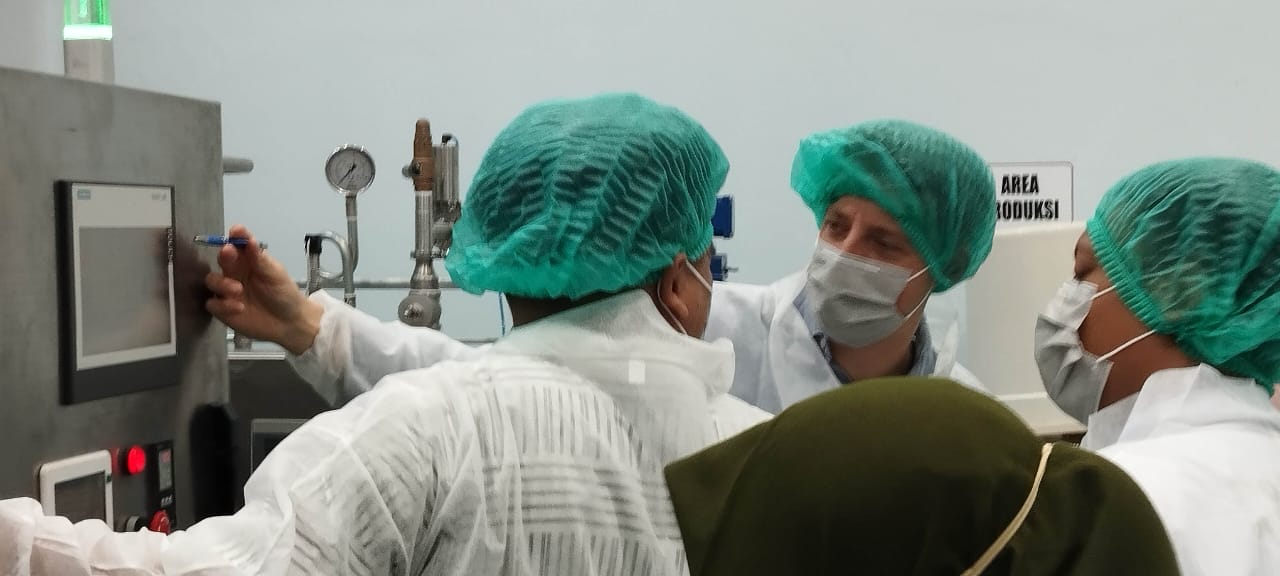
The third day of the workshop at Politeknik Negeri Jember (POLIJE) introduced participants to the production of sterilized milk, continuing the problem-based learning (PBL) approach at the TEFA Milk facility. Building upon the previous sessions on pasteurization and SOP development, this session emphasized the technical and industrial distinctions of sterilization, offering participants a broader understanding of dairy processing.
Led by POLIJE teachers, the training began with a detailed explanation of the sterilization process. Educators highlighted its key differences from pasteurization, particularly the use of high-temperature treatment to ensure product safety and significantly extend shelf life. This approach provided participants with insights into how technological variations can impact food quality, safety, and market value.
Hands-on practice once again became a hallmark of the session. Participants operated sterilization equipment under supervision, applying theoretical knowledge in a practical setting. Teachers guided them step by step, ensuring that the principles behind sterilization were clearly understood and correctly executed. This approach mirrored the way POLIJE prepares its students for real-world industry challenges.
Consultants from Skills for Competitiveness (S4C) observed the teaching delivery and praised the clarity of POLIJE’s instructions. They noted the effectiveness of integrating scientific explanations with live demonstrations, while also encouraging teachers to explore additional strategies for engaging students during highly technical exercises.
The session underscored POLIJE’s ability to combine rigorous academic content with industry-relevant training. By embedding problem-solving opportunities into practical activities, the institution demonstrated how PBL not only enhances technical skills but also fosters critical thinking and adaptability—qualities essential for graduates entering competitive industries.
Participants responded enthusiastically, showing curiosity and a strong willingness to engage in both discussions and demonstrations. Their active involvement reflected the success of POLIJE’s interactive teaching model, which prioritizes learner engagement as much as technical accuracy.
This PBL session also aligned with the broader goal of strengthening laboratory management at POLIJE. By equipping educators with practical and transferable skills, the institution ensures that its teaching factory serves as a bridge between academia and industry, fostering innovation in both learning and production practices.
Through initiatives like these, POLIJE continues to advance its vision of becoming a polytechnic of excellence. By integrating international perspectives, hands-on training, and industry-based problem solving, the institution reaffirms its role as a leader in vocational and applied education—producing graduates who are not only technically proficient but also globally competitive.