

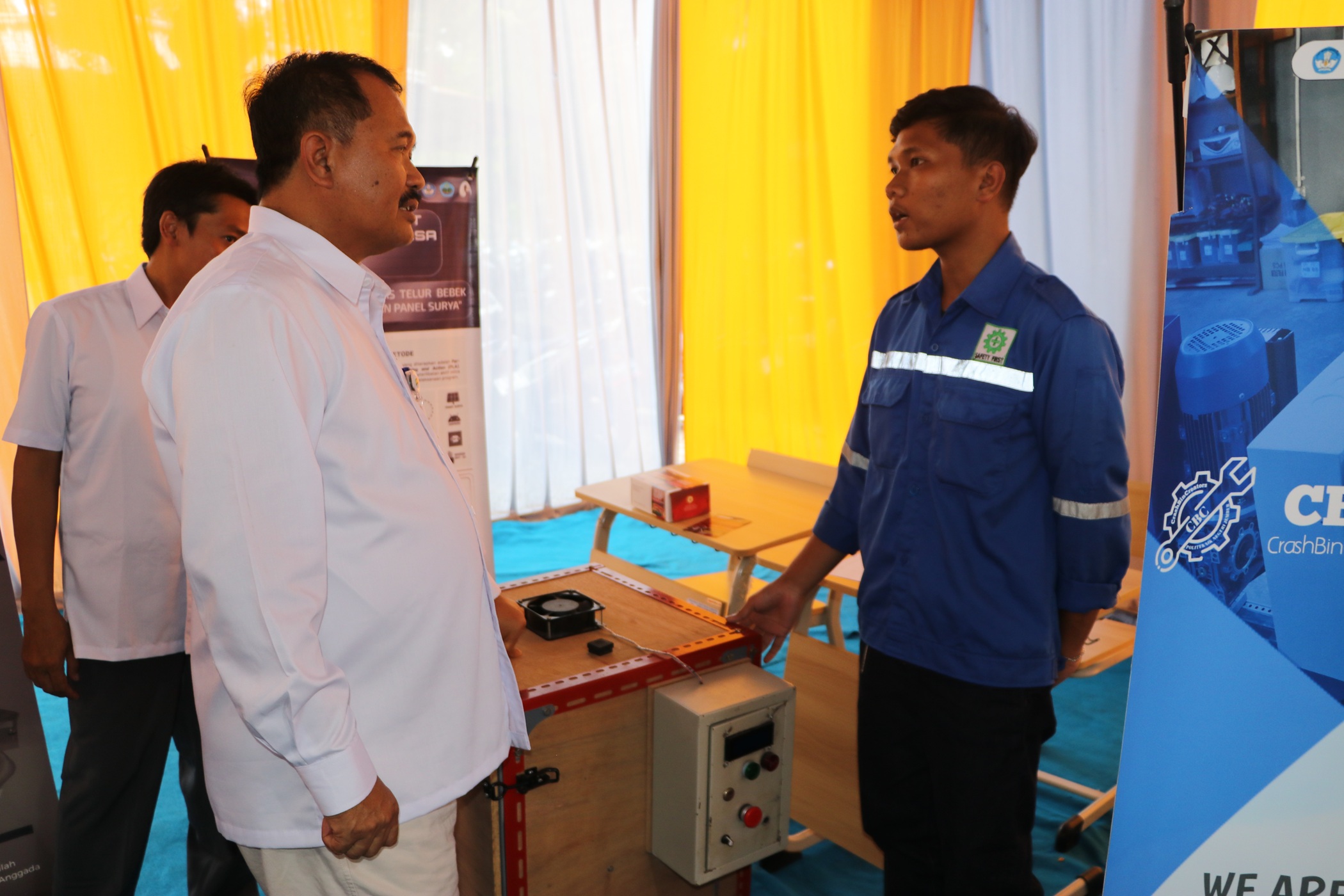
Students of Politeknik Negeri Jember (Polije) have once again achieved an innovation in applied technology. A group of students from the Mechatronics Engineering Technology Study Program successfully created a Smart Egg Incubator based on the Internet of Things (IoT). This automatic device is capable of intelligently and in real-time regulating the ideal temperature and humidity during the hatching process.
The innovation was developed by Sebastian Verdian Ximenes, S.Tr.T., as team leader, along with Erlanda Miko Prasetya, S.Tr.T, Akhmad Ja’far Maulana, S.Tr.T, and Amirul Khoiri, S.Tr.T. The device was created over one month, utilizing the Model Reference Adaptive Control (MRAC) method to maintain system stability during hatching.
The team leader, Sebastian Verdian Ximenes, explained that the device was designed to help farmers increase hatching efficiency without the need for continuous manual monitoring, supporting SDG 2 (Zero Hunger) through efficient food production.
“This system works automatically with temperature and humidity sensors like DHT22 that detect conditions inside the incubator. The data is sent to the microcontroller, and the system will automatically adjust the heater, fan, or humidifier to keep conditions stable,” Sebastian said.
Through IoT integration, users can monitor the incubator’s conditions directly via a smartphone or a Wi-Fi-based web dashboard. This technology allows farmers to control the device remotely with ease and efficiency.
“Condition data can be monitored real-time from anywhere. So, farmers do not need to be constantly on-site to ensure stable temperature and humidity. This certainly saves time and increases hatching success,” he added.
The main goal of developing this Smart Incubator is to increase egg hatching efficiency, reduce the risk of failure due to temperature changes, and encourage the application of digital technology in the poultry farming sector.
“We plan to add automatic egg turning features, smartphone notifications, and integration with solar energy. That way, the device can become a solution for modern farmers while also supporting energy sustainability,” Sebastian concluded.