

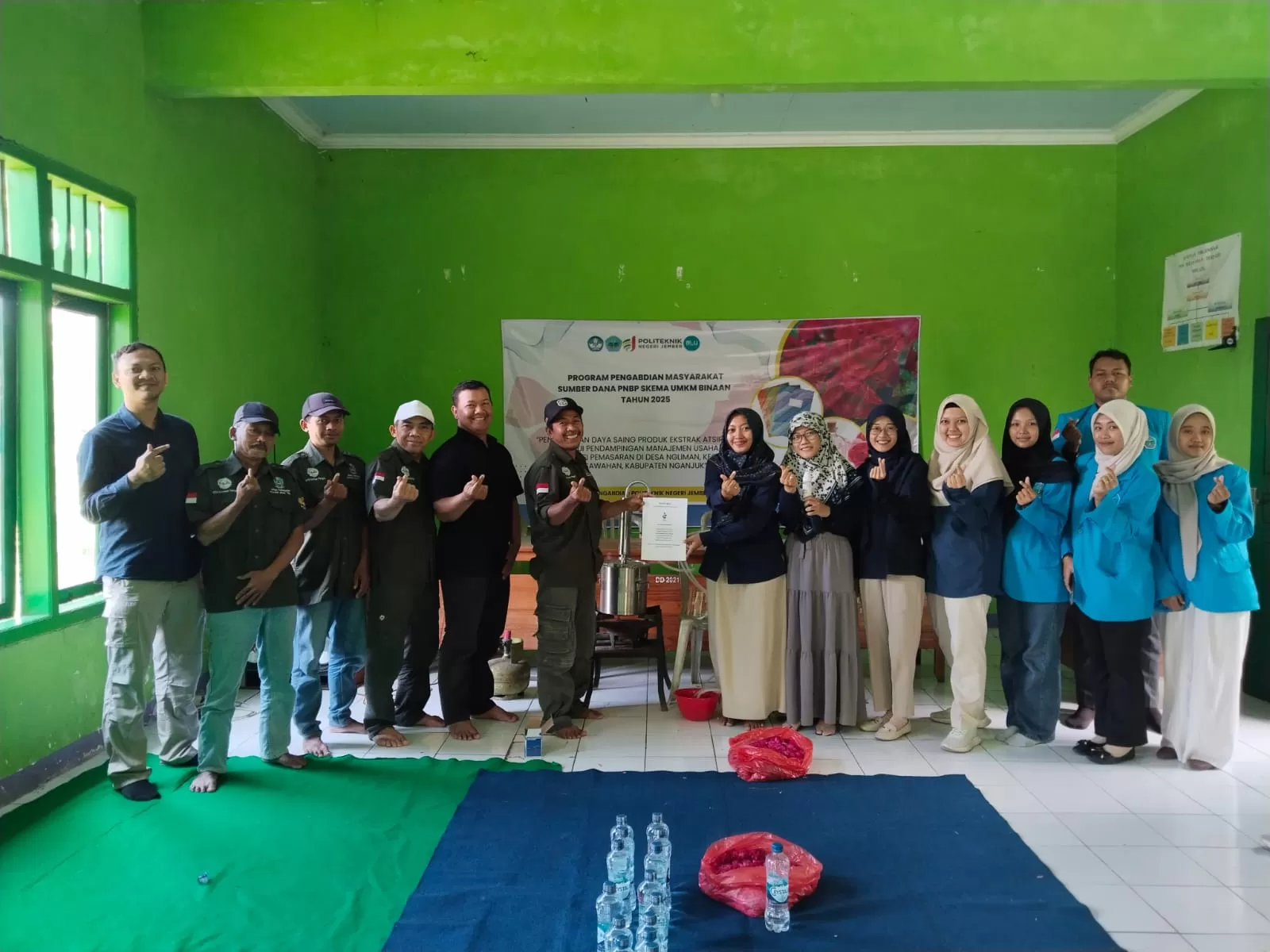
The Community Service Team of Jember State Polytechnic (Polije) has provided specialized assistance to the Sumber Pangan Forest Farmers Group (KTH) in Bruno Hamlet, Ngliman Village, Sawahan District, Nganjuk Regency.
This initiative aligns with the United Nations Sustainable Development Goals (SDGs), particularly Goal 8 (Decent Work and Economic Growth), Goal 9 (Industry, Innovation, and Infrastructure), and Goal 12 (Responsible Consumption and Production).
Led by Suwinda Fibriani, S.P., M.Biotek., from the Agribusiness Management Study Program, PSDKU Nganjuk, the program involved lecturers from multiple Polije campuses. The assistance focused on enhancing the production capacity of rose essential oils, strengthening business management, and introducing digital marketing innovations to improve economic sustainability in rural communities.
Farmers were introduced to the use of distillation machines to improve the efficiency and quality of essential oil extraction. In addition, they received training on digital financial recording systems and online marketing strategies to enhance transparency, accountability, and product visibility in broader markets. The Polije team also conducted monitoring and evaluation sessions to assess improvements in product quality and the professional management of the farmers’ cooperative.
“Our goal is to ensure that farmers are not only skilled in production but also capable of managing finances and promoting their products through modern, technology-driven approaches,” said Suwinda Fibriani.
The initiative was warmly welcomed by local farmers. The Head of KTH Sumber Pangan, Bambang Heru Sukarwan, expressed his optimism, stating, “This program has opened our minds and given us new hope for developing our rose essential oil business.”
Through this sustainable community empowerment program, Polije aims to establish KTH Sumber Pangan as a model for technology-based rose essential oil development in Indonesia. The initiative also seeks to improve farmers’ welfare by fostering innovation, inclusivity, and competitiveness, thereby contributing to national rural development and the realization of the SDGs agenda in local agricultural communities.