

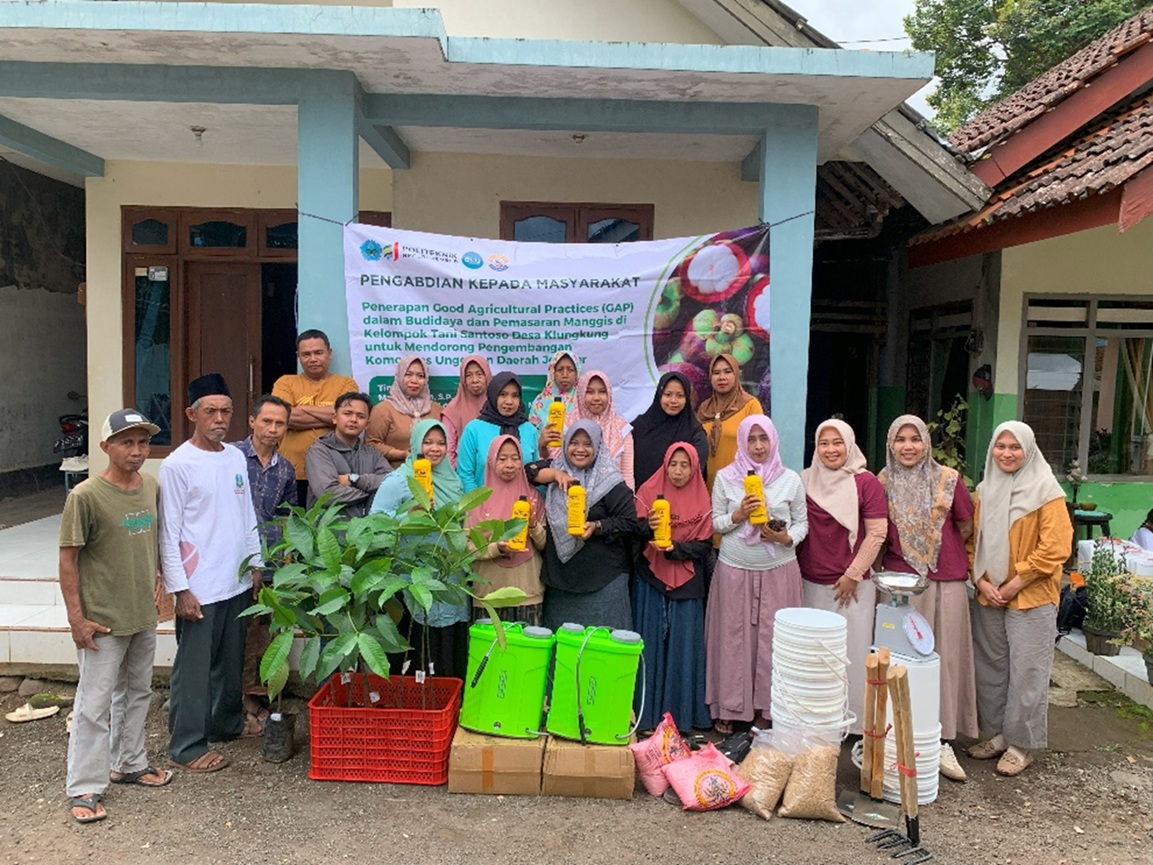
The Community Service Team from the Department of Agricultural Production at Politeknik Negeri Jember (Polije) has conducted a Good Agricultural Practices (GAP) training program with the Santoso Farmers Group in Klungkung Village, Jember Regency. The initiative aims to improve farmer welfare while enhancing the quality of mangosteen, a signature tropical fruit of the region.
The program, funded by the 2025 DPPM scheme under the Directorate General of Higher Education, Research, and Technology, focuses on tackling the yellow sap disease, which has significantly reduced fruit quality and lowered selling prices. “In the past, we harvested tons of mangosteen, but now profits are hard to achieve. Many fruits are affected by yellow sap, prices drop, and some are unsellable,” said Ibni Hasim, head of the Santoso Farmers Group.
Led by Maria ‘Azizah, S.P., M.Si, alongside lecturers Nur Aini Alfiah, S.P., M.Si, and Descha Giatri Cahyaningrum, S.P., M.P, the Polije team trained farmers on GAP-based cultivation practices—from planting and maintenance to post-harvest handling. “Mangosteen, known as the Queen of Tropical Fruits, can overcome yellow sap issues through proper farming practices. We also introduced organic fertilizers to help farmers become self-reliant. Our goal is not to lecture but to collaborate and learn together,” Maria explained.
Field surveys revealed that traditional practices still dominate, such as unbalanced fertilization, random pruning, and poor post-harvest hygiene. Through the program, farmers learned proper sanitation pruning to improve airflow and reduce fungal infections, as well as the application of calcium fertilizers before the flowering stage, which helps suppress yellow sap outbreaks. These interventions have already shown positive results, with healthier trees, fewer infections, and improved fruit quality.
The initiative resonates beyond the local level, reflecting global demand for premium tropical fruits. According to ITC Trade Map (2024), the international mangosteen market is valued in billions of dollars, with growing expectations for quality and sustainability. By adopting GAP, Klungkung farmers are better positioned to access export markets, supporting Indonesia’s standing as one of Southeast Asia’s key mangosteen exporters while demonstrating the crucial role of academia in advancing sustainable agriculture.