

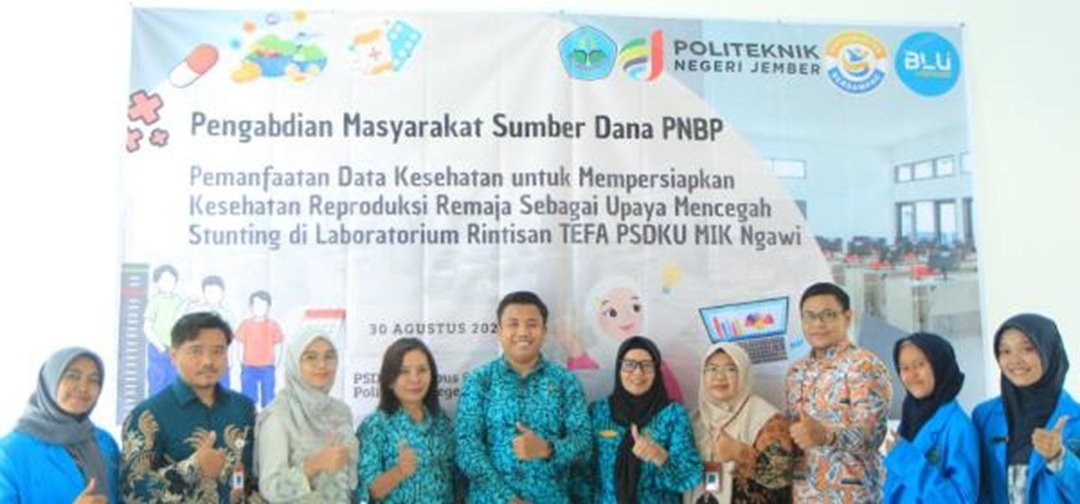
The Health Information Management Study Program (MIK) of Politeknik Negeri Jember (Polije) PSDKU Campus 5 Ngawi carried out a community service program (PPM) with the theme “Utilizing Health Data to Prepare Adolescent Reproductive Health as an Effort to Prevent Stunting.” The activity took place at the Teaching Factory (TeFa) Laboratory of PSDKU MIK Ngawi.
The program was led by a multidisciplinary team of lecturers: Ns. Kurniawan Erman Wicaksono, S.Kep., M.Kes.; Nesa Ayu Murthisari Putri, S.Tr.Keb., M.K.M.; Titin Andriyani Atmojo, S.TP., M.Agr.; Budi Fajar Supriyanto, S.Kom., M.Kom.; and Waridad Ummais Al Ayyubi, S.E., M.M. Students also took part as community facilitators.
According to the 2023 Indonesian Nutritional Status Survey (SSGI), the stunting prevalence in Ngawi remains at 15.3 percent, partly due to high rates of anemia among adolescent girls. Addressing this issue, the PPM focused on strengthening adolescent health cadres through training in the use of health data with adolescent health examination cards.
“Through this program, we want to raise awareness that adolescents play a key role in breaking the cycle of stunting from an early stage,” explained Ns. Kurniawan Erman Wicaksono, the activity coordinator.
In addition to training, the lecturers also provided education sessions for teenagers on reproductive health, anemia prevention, the importance of iron supplementation, and the use of local food resources. The initiative involved close collaboration with the Ngawi District Health Office and the Posyandu ILP team from Geneng Community Health Center (Puskesmas Geneng).
By combining the strengths of higher education, health professionals, and the local community, the Teaching Factory Laboratory of PSDKU MIK Ngawi reinforced its role as both a learning center and a community service hub that delivers practical solutions for public health.