

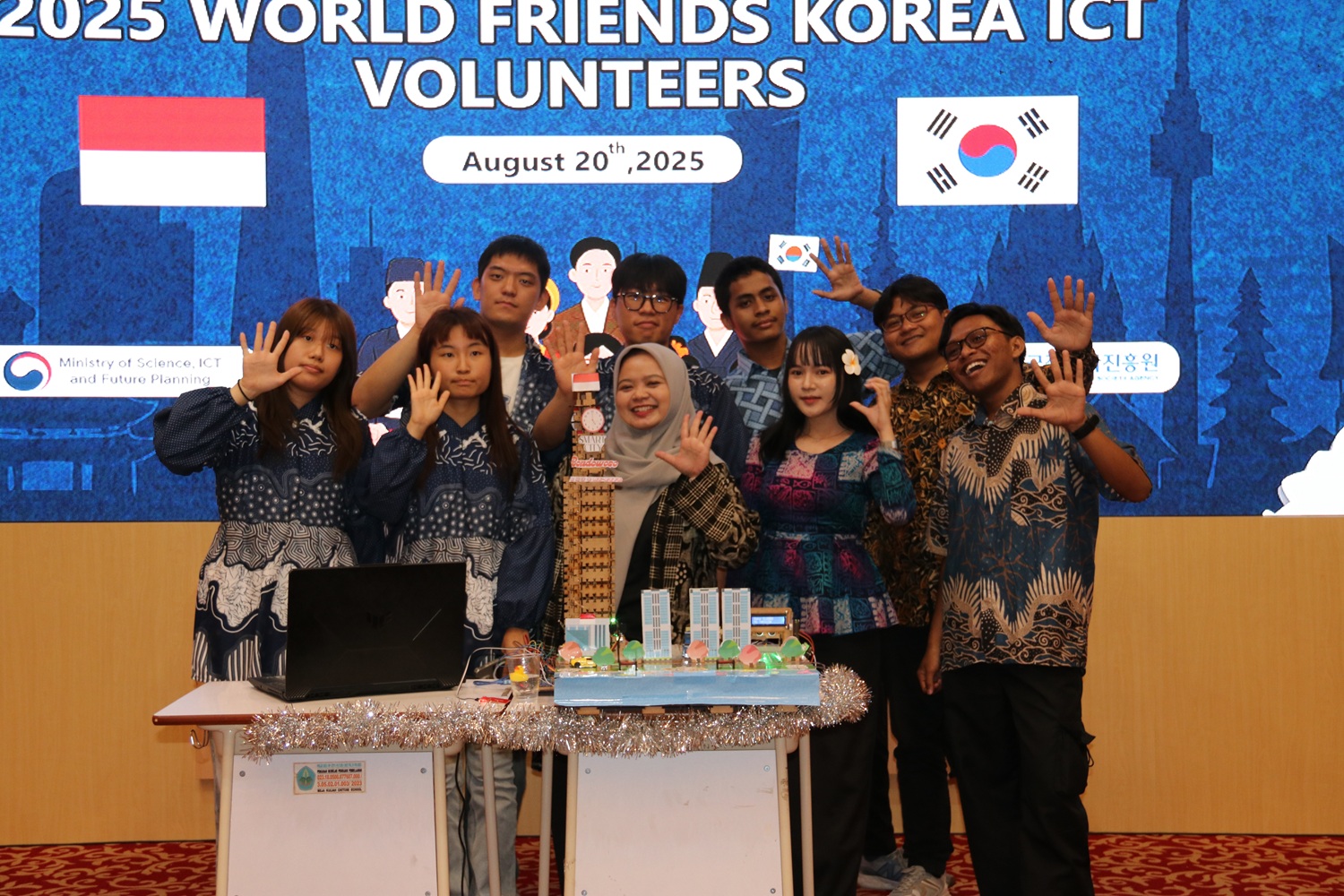
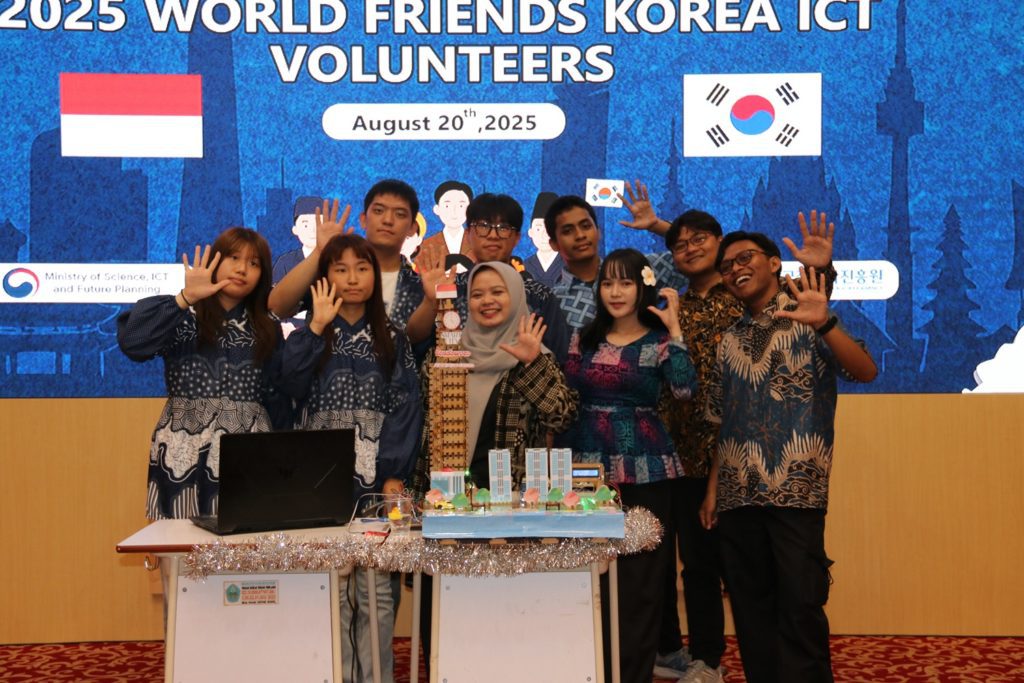
The WFK-ICT Volunteering Program 2025 has brought together a dynamic collaboration between Kyungpook National University (KNU), South Korea, and Politeknik Negeri Jember (POLIJE), Indonesia. This international initiative allows students from both institutions to work hand-in-hand in applying digital technology and smart solutions for community development. This year’s project focuses on the Smart City Bondowoso initiative, which addresses pressing urban challenges with innovative systems.
The project team, known as Team Five, consists of Korean and Indonesian students, including Kwak Taehun, Kim Seungeun, Nam Gyumin, and Lee Hwayeong from KNU, alongside Muhammad Zaky, Muhammad Zidan, Azrieal Akbar, and Cantika Tri Wahyuni from POLIJE. Their collaboration represents a cross-cultural and interdisciplinary effort to design real solutions for everyday urban problems.
Through initial field research in Bondowoso, the team identified key issues in the city’s infrastructure and daily life, particularly around the hotel area. They noted difficulties in finding available parking spaces, the lack of early flood warning systems, and high energy consumption from traditional street lighting. These observations became the foundation of their innovative project proposals.
The team developed three primary solutions: a Smart Parking System, an Early Flood Warning System, and a Smart Streetlight System. The Smart Parking System utilizes proximity sensors to detect available parking slots and an automatic gate system, making urban mobility more efficient. The Early Flood Warning System integrates water level sensors in rivers and drainage areas, capable of sending real-time alerts to residents and local authorities. Meanwhile, the Smart Streetlight solution uses motion and light sensors to optimize electricity use by automatically adjusting brightness based on activity and natural light conditions.
To implement these ideas, the students assembled prototypes using Arduino kits, integrating ultrasonic sensors, LDR (Light Dependent Resistors), and water level sensors. Each prototype was tested and refined to ensure functionality and adaptability to real-world conditions. The technological integration demonstrates how low-cost, open-source hardware can contribute to smart city innovation in developing regions.
The verification process included live testing, evaluations, and feedback collection from potential users. According to the team, this stage was crucial in ensuring that their solutions were not only functional but also practical and relevant to the needs of Bondowoso residents. With successful prototype trials, the project showcases how academic collaboration can directly contribute to community problem-solving.
Beyond the technical outcomes, the program emphasizes internationalization and cultural exchange. POLIJE and KNU students had the opportunity to share knowledge, exchange cultural values, and strengthen mutual understanding. This aligns with POLIJE’s vision to become a global polytechnic and expand international cooperation for innovation and education.
The WFK-ICT Volunteering Program 2025 not only highlights technological innovation but also symbolizes the strong bond of academic partnership between Indonesia and South Korea. By working together on projects like Smart City Bondowoso, KNU and POLIJE contribute to shaping future leaders who are capable of addressing global challenges through technology, collaboration, and community engagement.