

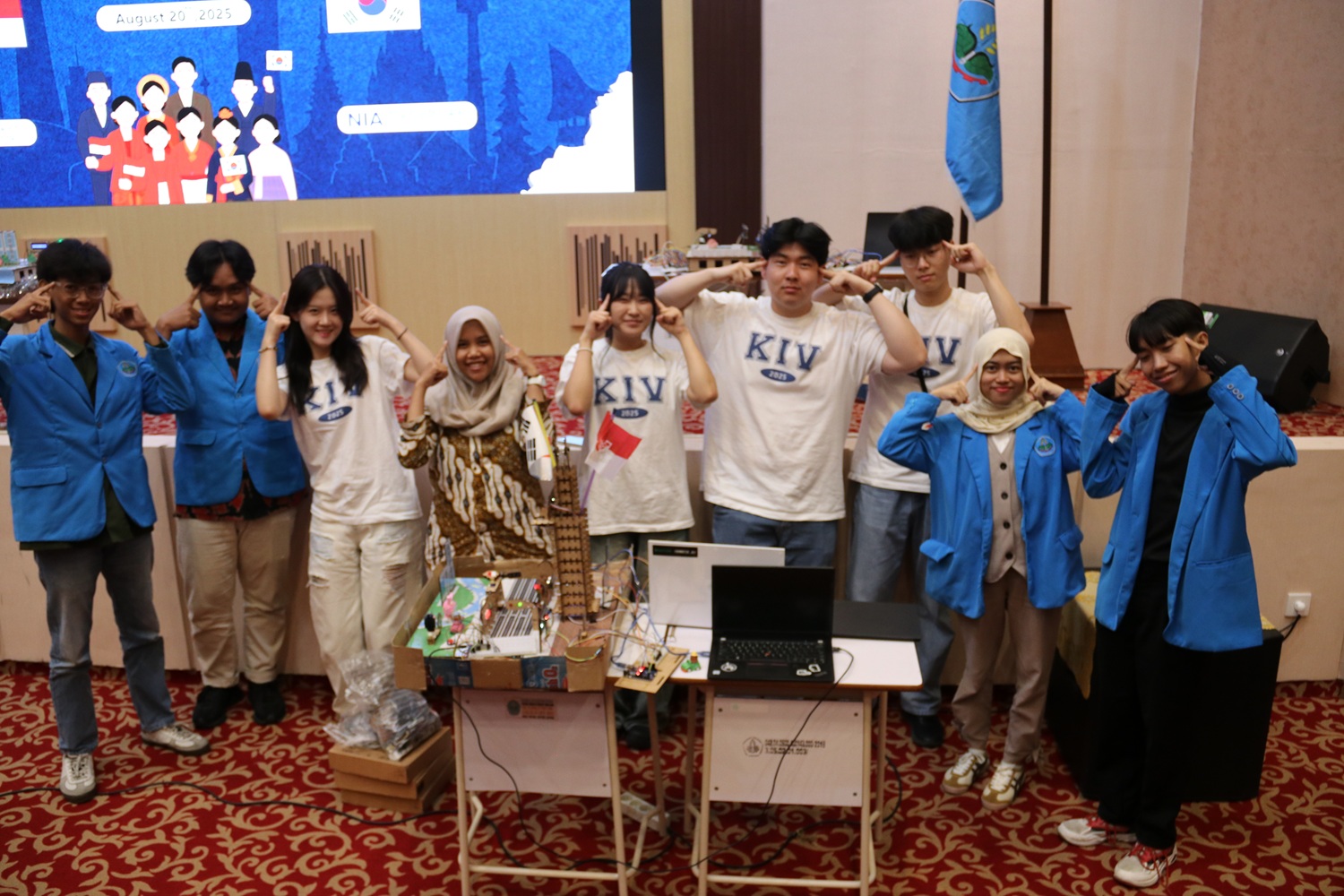

To tackle the increasing number of road accidents in East Java, particularly those involving pedestrians, students from Kyungpook National University (KNU), South Korea, and Politeknik Negeri Jember (POLIJE), Indonesia, developed an innovative IoT-based Smart Pedestrian Crossing System. This project was carried out under the 2025 World Friends Korea-ICT Volunteering Program (WFK-ICT) and focuses on improving pedestrian safety in Bondowoso.
Traffic accidents remain a serious problem in East Java. In 2023 alone, there were approximately 31,922 accidents, with 5,240 fatalities, making the region the highest in Indonesia. Bondowoso Regency also recorded 514 accidents in 2024, with 92 fatalities and over 700 injuries. Alarmingly, many of these casualties involved pedestrians crossing roads at unsafe spots.
To respond to this challenge, the team—consisting of KNU students Kim Mina, Sim Seyun, Son Minyoung, and Noh Eunsoo, alongside POLIJE students Aisyah Hamda, Adib Maulidan, Ganendra Justine, and M. Anang Ma’ruf—designed a Smart Pedestrian Crossing System equipped with traffic sensors and weather detection technology. Their solution aims to provide both safety and comfort for pedestrians while promoting driver discipline.
The system works by allowing pedestrians to press a button manually or via a website. Ultrasonic sensors detect approaching vehicles within five meters. If vehicles are detected, the system displays a “Wait” signal until the road is safe. Once clear, the vehicle traffic light turns red, a safety gate closes, and the pedestrian light turns green, allowing safe passage across the road.
To improve comfort, the system integrates weather-sensitive features. When the temperature rises above 28°C, an automatic umbrella opens to protect pedestrians from heat. During rain, the umbrella also activates, providing shelter. Additionally, a Safe Light ensures visibility at night or in dim conditions, reducing the risk of accidents in poorly lit areas.
The case study for implementation was carried out on Jl. A. Yani, Bondowoso, a busy road with heavy motorcycle and public transportation traffic. This location was selected due to its high accident risk, especially for vulnerable groups such as children going to school and elderly residents. The team emphasized that Bondowoso provides an ideal pilot site before scaling the solution to other cities.
The impact and benefits of the system are significant. For the community, it ensures safer crossings, comfort while waiting, and a sense of security at night. For the local government, it reduces accident rates, supports smart city initiatives, and improves the region’s public image. Furthermore, the system can provide real-time data on traffic and pedestrian use, useful for future urban planning.
The Smart Pedestrian Crossing System reflects the program’s goals of combining technical innovation with social responsibility. By applying design thinking methodology—empathizing, defining, ideating, prototyping, and testing—the project not only delivers a functional prototype but also a model for broader smart city development.
Through this initiative, KNU and POLIJE students demonstrated how international cooperation and IoT-based innovation can address real community needs. Their project represents a step forward in making Bondowoso a safer, smarter, and more inclusive city.