

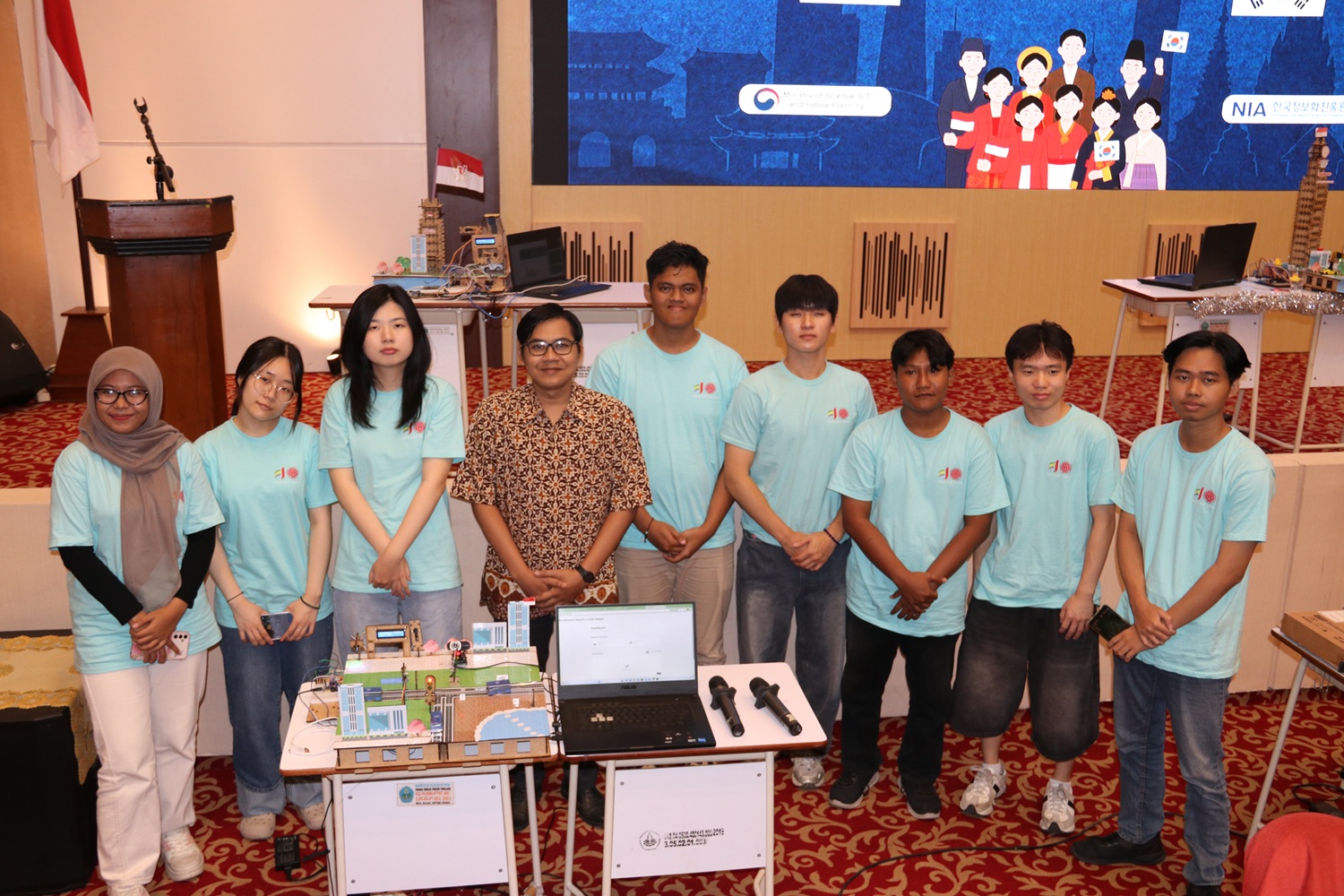
As part of the 2025 World Friends Korea-ICT Volunteering Program (WFK-ICT), students from Kyungpook National University (KNU), South Korea, and Politeknik Negeri Jember (POLIJE), Indonesia, introduced a breakthrough project for Bondowoso Smart City: an AI-based Violence and Car Crash Detection System. The initiative, developed by Team 2 KitaCode, aims to improve urban safety by using artificial intelligence for real-time monitoring and reporting.
The project addresses urgent issues faced in Bondowoso, including gang-related violence (klitih), insufficient police response due to lack of evidence, frequent fatal car crashes, and even communication barriers between Madurese and Indonesian languages. By combining AI and IoT, the team designed a solution capable of real-time detection and automated incident reporting.
The system utilizes AI-driven object detection models (YOLOv11) integrated with a Flask backend and Firebase database. Cameras installed in monitoring areas are able to detect violent incidents or car crashes. Once detected, alerts are immediately sent to police units through a mobile application that includes photos, videos, and incident reports.
In the event of a violent altercation, the system activates a hardware prototype consisting of an ESP32 microcontroller connected to an LED and buzzer, which signals that an incident is occurring. For car crashes, the system provides detection results via a web platform, displaying images of accidents along with relevant information to assist in quick response.
The AI model was trained using a fight dataset containing images of violent and non-violent scenarios. With data augmentation techniques such as rotation, flipping, scaling, and color adjustments, the model achieved an accuracy rate of approximately 82% mAP (mean Average Precision), making it reliable for real-world detection. A similar model was also trained for car crash detection, with ongoing efforts to expand the dataset for higher accuracy.
To overcome local communication barriers, the team also explored integrating a Madurese-Indonesian NLP (Natural Language Processing) model to support automatic incident reporting in local languages. This ensures inclusivity and better accessibility for residents in multilingual contexts.
Future plans for the project include optimizing deployment on NVIDIA Jetson Orin Nano for faster edge AI processing, improving dataset accuracy, and establishing direct collaboration with the Bondowoso police to integrate the system into official response workflows.
The team, consisting of KNU students Kwon Hyeongjun, Yun Sanghyun, Choi Yeonwoo, and Kim Yunjin, along with POLIJE students M. Dien Vito Alivio Hidayat, Ahmad Bayu Putra Dewantara, Ach. Bahrul Ma’arip, and Aisyah Nur Fadilah, worked under the guidance of advisor Wahyu Pebrianto, S.Tr.Kom., M.T.. Their project not only showcases advanced AI applications but also emphasizes the importance of international collaboration in tackling urban safety challenges.
The AI-based Violence and Car Crash Detection System is a significant milestone in the Bondowoso Smart City agenda. It proves how student-led innovation, backed by international cooperation, can create real impact for community safety and serve as a model for other regions in Indonesia and beyond.