

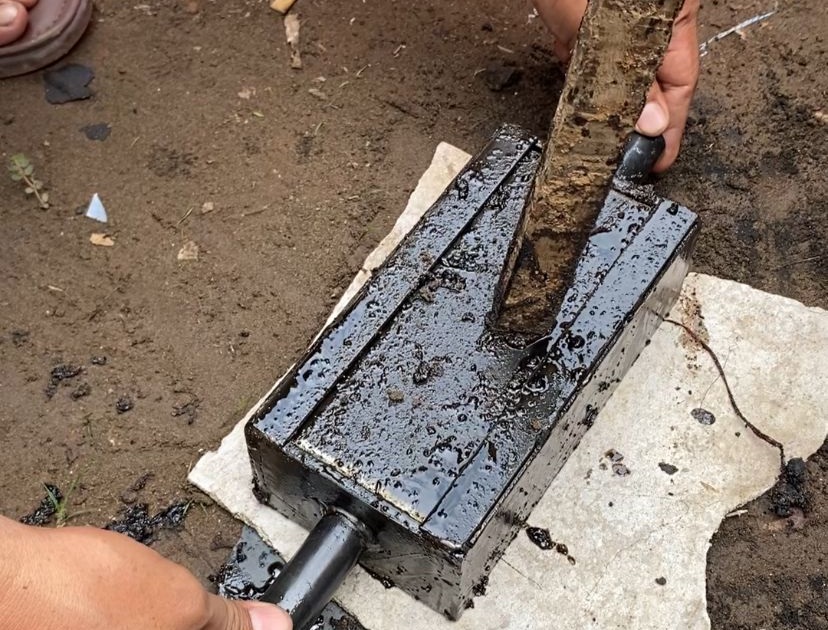
Students from Politeknik Negeri Jember (Polije) have once again demonstrated their commitment to sustainability by developing EcoPaving—an innovative paving block made from recycled plastic waste. This solution not only addresses the growing issue of plastic pollution but also offers an eco-friendly, economically viable alternative to conventional building materials.
The innovation emerged from a student-led project aimed at promoting waste management through simple, community-based technology. Diyah, one of the program’s initiators, explained that the production process is practical and replicable at the local level.
“We start by shredding plastic waste—such as used bottles and plastic bags—into small pieces, then heating them at 150 to 180 degrees Celsius until they melt,” she said.
Once melted, the plastic is gradually mixed with sand and a small amount of used motor oil, forming a dense, dough-like consistency. The mixture is then poured into paving molds, pressed, and left to cool and solidify. The result is a strong, durable paving block that is more environmentally friendly than traditional cement-based products.
“With EcoPaving, we hope to raise public awareness about plastic waste management and show that it can be transformed into useful, marketable products—such as green construction materials,” Diyah added.
The project has received positive feedback from local communities and stakeholders, highlighting its potential as both an environmental solution and a tool for community empowerment. By using easily accessible materials and low-tech production methods, EcoPaving can be adopted widely as a grassroots solution to plastic waste.
This innovation also responds to the global challenge of plastic overconsumption. With plastic waste expected to triple by 2060 according to OECD projections, local solutions like EcoPaving are more important than ever. They demonstrate how circular economy principles—reducing, reusing, and recycling—can be applied creatively to meet local infrastructure needs while protecting the environment.
Beyond its environmental impact, EcoPaving embodies the transformative power of vocational education. It shows how students can act as catalysts for sustainable change, blending practical skills with social awareness to create scalable, real-world solutions.
As the world looks for inclusive and low-cost innovations to address environmental degradation, the success of EcoPaving from Polije affirms that meaningful change can start at the community level—with plastic waste reimagined not as a problem, but as a resource for building a greener future. (rda)